
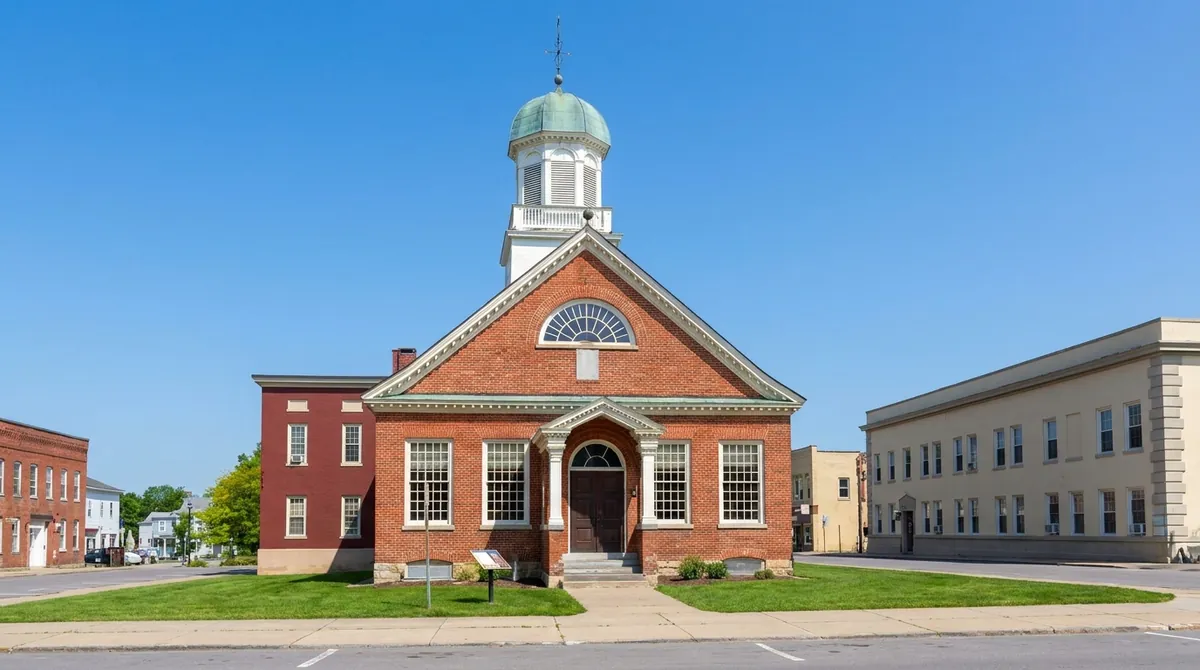
Court records in Fulton County, New York are maintained by the County Clerk and the clerks of individual courts, and can be accessed through online search tools, official court portals, and in-person visits to the clerk's office. FultonNYCourt.us can help you find publicly available court record information for Fulton County. Additional access points include the Fulton County County Clerk's Office, the New York State Unified Court System's online resources, and various state government databases.
Fulton Court System Overview
Fulton County is part of the Fourth Judicial District of the New York State Unified Court System, which also includes the counties of Clinton, Essex, Franklin, Hamilton, Montgomery, Saratoga, Schenectady, St. Lawrence, Warren, and Washington. The county seat is Johnstown, where the primary courthouse is located. New York's court system is administered statewide by the Office of Court Administration under the Chief Administrative Judge, with local administration handled by district administrative judges assigned to each judicial district.
Fulton County's courts operate out of the county courthouse complex in Johnstown. The Fulton County Courthouse handles Supreme Court, County Court, Family Court, and Surrogate's Court matters.
Fulton County Courthouse
Courts Serving Fulton County
Several courts at the state and federal level serve Fulton County residents. Below is a summary of each court with contact details.
State Courts
Fulton County Supreme Court & County Court
Fulton County Family Court
Fulton County Surrogate's Court
City Court of Johnstown
City Court of Gloversville
In addition, each town and village in Fulton County has a local justice court (town court or village court) that handles traffic violations, minor criminal matters, and small claims within its jurisdiction.
Federal Court
U.S. District Court for the Northern District of New York
Fulton County falls within the Northern District of New York for federal civil and criminal cases. Federal bankruptcy matters are also handled by the U.S. Bankruptcy Court for the Northern District of New York in the same district.
What Types of Cases Fulton County Courts Hear
Courts serving Fulton County handle a wide range of case types across multiple divisions:
- Criminal: Felonies, misdemeanors, violations, and infractions
- Civil litigation: Contract disputes, personal injury, property disputes, and monetary claims of all amounts
- Small claims: Informal proceedings for disputes up to the statutory dollar limit
- Family law: Divorce, custody, child support, paternity, orders of protection, and adoption
- Probate and estates: Wills, estate administration, guardianships, and trusts
- Juvenile: Juvenile delinquency, persons in need of supervision (PINS), child protective proceedings
- Traffic: Vehicle and traffic law violations, including DWI/DUI arraignments
The sections below explain which court handles each type of matter.
District Court Cases in Fulton County
New York does not use the term "district court" at the county level outside of New York City and Nassau/Suffolk counties. In Fulton County, the equivalent trial courts of general jurisdiction are Supreme Court and County Court.
- Supreme Court has unlimited original jurisdiction over civil matters, including cases involving large monetary amounts, matrimonial actions (divorce), and equity proceedings. It also hears Article 78 proceedings challenging government actions.
- County Court handles all felony criminal prosecutions in Fulton County. Felony cases typically begin in a local justice court or city court with an arraignment and preliminary hearing, then proceed to County Court by grand jury indictment or superior court information.
County Court also has civil jurisdiction for claims up to $25,000 and hears appeals from city courts, town courts, and village courts. Cases are assigned to the sitting County Court judge. Supreme Court matters may be heard by a justice assigned to the Fourth Judicial District.
Magistrate Court Cases in Fulton County
In Fulton County, the local justice courts (town and village courts) and the two city courts — Johnstown City Court and Gloversville City Court — function as courts of limited jurisdiction, similar to magistrate courts in other states.
These courts handle:
- Misdemeanors and violations
- Felony arraignments and preliminary hearings
- Vehicle and traffic infractions
- DWI/DUI arraignments and hearings
- Civil claims up to $15,000 (in city courts)
- Small claims up to $5,000 (in city courts) and up to $3,000 (in town and village courts)
- Landlord-tenant disputes and eviction proceedings
The Fulton County Centralized Arraignment Part (CAP) is maintained at the county correctional facility, where after-hours arraignments take place for individuals arrested by local police agencies.
Family Law, Probate, and Juvenile Matters in Fulton County
Family Law
Fulton County Family Court handles custody, visitation, child support, paternity, orders of protection, family offenses, and termination of parental rights. Divorce and matrimonial actions are filed in Supreme Court. If you need to file for an order of protection or a child support petition, start at Family Court on North William Street in Johnstown.
Probate
Fulton County Surrogate's Court handles all probate matters, including the administration of decedent estates, probate of wills, guardianship of minors' property, and trust proceedings. The Surrogate's Court is located in the county courthouse on West Main Street.
Juvenile
Juvenile delinquency cases, PINS (Persons in Need of Supervision) proceedings, and child protective cases under Article 10 of the Family Court Act are heard in Fulton County Family Court. Juvenile records are confidential under New York law and are not available through public record searches.
How Cases Move Through the Fulton County Court System
- Filing or initiation: Criminal cases begin with an arrest or the filing of a criminal complaint. Civil cases start with the filing of a summons and complaint. Family and probate matters are initiated by petition.
- Arraignment or initial appearance: In criminal cases, the defendant is arraigned in a local court or at the Centralized Arraignment Part. In civil cases, a scheduling conference or return date is set.
- Grand jury or preliminary hearing (felonies): Felony charges are presented to a grand jury for indictment, after which the case moves to County Court.
- Pre-trial phase: Both sides exchange discovery, file motions, and in criminal cases, engage in plea negotiations. Civil cases may involve depositions and settlement conferences.
- Trial or resolution: Cases proceed to a bench trial or jury trial, or are resolved by plea agreement, settlement, or default judgment.
- Post-judgment: Criminal cases move to sentencing. Civil judgments may be enforced or appealed. Appeals from Fulton County courts go to the Appellate Division, Third Department, in Albany.
Court Administration, Local Rules, and Public Access in Fulton County
Administration
Fulton County's courts are administered under the Fourth Judicial District of the New York State Unified Court System. The Administrative Judge for the Fourth Judicial District oversees operations across all counties in the district. Day-to-day court operations in Fulton County are managed by the Chief Clerk of the court.
Local Rules
Local court rules for the Fourth Judicial District, including rules governing motion practice, discovery, and trial procedures, are published on the New York State Unified Court System website at nycourts.gov. Individual judges may also publish part rules governing practice before them.
Public Access
Under New York law, most court records are presumptively open to the public. Sealed records, youthful offender adjudications, juvenile proceedings, and certain family court matters are exceptions. The Fulton County Clerk's Office maintains land records, civil Supreme Court and County Court case files, and judgments. The Clerk's Office offers an online public search portal where searchers can access recorded documents. Subscription fees apply: $50 per month for in-state users, with a $15 option for 24-hour access and $5 per document to print.
Attending Hearings
Court proceedings in Fulton County are generally open to the public. Some hearings may be conducted by video or telephone, particularly in Family Court and for certain arraignments. Contact the specific court for current policies on remote appearances.
Contact
Fulton County Clerk's Office
Court Records and Related Court Resources in Fulton County
- Online court record search: The New York State Unified Court System provides the eCourts portal for searching civil Supreme Court and County Court case information statewide, including Fulton County cases.
- County Clerk public records: The Fulton County Clerk's Office manages deeds, mortgages, business certificates, judgments, and other recorded documents. Online searches are available through the SearchIQS portal.
- Criminal records: The New York State Division of Criminal Justice Services (DCJS) maintains the state's criminal history repository. Individuals can request their own records through DCJS.
- Inmate lookup (state): Use the DOCCS Incarcerated Lookup tool to search for individuals in New York State correctional facilities.
- Inmate lookup (county): The Fulton County Department of Corrections operates the county jail at 2710 State Highway 29, Johnstown. Contact them at (518) 736-2118 for inmate information. The Fulton County Sheriff's Office also provides access to VINE inmate notification services.
- Sex offender registry: Search the New York State Sex Offender Registry for information on Level 2 and Level 3 registered sex offenders.
- Wanted persons: The New York State Police Wanted and Missing page lists individuals wanted on criminal warrants.
- Tax warrants: The New York State Tax Warrant search tool allows you to look up open state tax warrants.
- Vital records: Birth, marriage, death, and divorce records are available through the New York State Department of Health and the New York State Library. Local vital records may also be obtained from the city or town clerk where the event occurred.
- Property records: The Fulton County Real Property Tax Service Agency provides tax map and assessment data. The Fulton County Map Viewer offers an interactive GIS tool for property research.
- Court forms and self-help: New York State court forms are available through the Unified Court System website at nycourts.gov/forms. Self-represented litigants can access guides, instructions, and DIY forms for common proceedings including divorce, name changes, small claims, and landlord-tenant matters.